We’ll come right out and say it. At Greatland Adventures, we’re against using the Kp-index as an aurora forecasting tool. Not in a conspiratorial or sarcastic sort of way, of course, but in an “We’ve been doing this long enough to know better” kind of fashion.
What is the Kp-index, exactly?
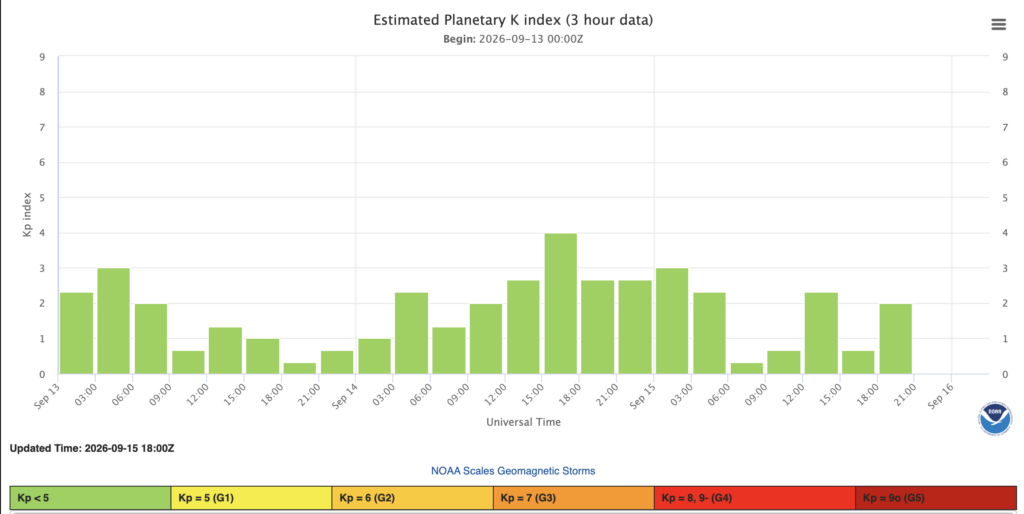
The Kp-index is a global measure of geomagnetic activity. It’s calculated by averaging data from ground-based magnetometer stations around the world, and it updates every three hours. Offering a number between 0 and 9, when the Kp-index reflects a higher number, the more widespread the geomagnetic disturbance may be. The local Kp-index (short for Planetarische Kennziffer, German for “planetary characteristic digit”) was invented by Julius Bartels, a German geophysicist and statistician in 1939, followed by the 1949 planetary Kp-index. Bartels created the Kp index to quantify the magnetic effects of “solar corpuscular radiation” (what is known today as the solar wind) interacting with Earth’s magnetosphere.
A future, predictive Kp-index is based on the Sun’s 27-day cycle and the three-day forecast of solar wind based solely on photographs of the Sun. It is, like many things in science, an educated guess. A present Kp-index number reflects what happened within the last three hours. A past Kp-index is accurate, but only on a global level. To simplify, utilizing the Kp-index to predict an aurora display is like using a global measurement of precipitation to forecast rain near one’s home.
Yes, the Kp-index is everywhere. That doesn’t make it right.
If you’ve ever googled “northern lights forecast,” you’ve seen it. Forecasting apps, aurora-chasing websites, social media posts; everyone references the Kp-index. A Kp of 5 or higher and all the phone notifications blow up. A Kp of 1 and everyone stays home.
We’ve chased the aurora outside Anchorage and Fairbanks on nights with a Kp reading of 0 and watched brilliant aurora displays light up the entire sky. We’ve also seen nights with a Kp of 5 or 6 where the sky stayed dim. The global Kp-index will barely change when a substorm (a sudden burst of energy that often causes the aurora to pulsate) happens, and since substorms last only 15-30 minutes and are highly localized, this is why we don’t plan an aurora chase based solely on a Kp-index number.
Also, here’s the catch: The term “widespread” with respect to aurora displays doesn’t always mean “visible” aurora, and three-hour updates are not helpful for a condition that can explode across the sky one minute, then fade away the next. Fun fact: The Kp-index was never designed to be a real-time aurora viewing tool, and exists merely to act as an indicator of space weather intensity as a warning tool against potential technological disruptions. But somewhere along the way, the Kp-index was adopted by the northern lights tourism industry as a default shorthand answer to “Will I see the lights tonight?”
How we build a sharper aurora forecast in Anchorage and Fairbanks
Our all-local aurora team and guides use a combination of real-time data sources that give a much sharper, faster, and more accurate picture of what the aurora is doing right now.
We check the possibility of the tours every day at 3 p.m., primarily looking at cloud cover. If we can locate partly clear skies, we’ll be in a good position to see the aurora, if it appears. Greatland utilizes several viewing locations within a three-hour radius of both Anchorage and Fairbanks, and uses several tools to locate clear skies, transporting guests to those places to view the northern lights.
Aurora live cam view from Greatland Adventures’ Fairbanks aurora cabin
Can we accurately predict the aurora?
Accurately predicting aurora beyond 70 minutes into the future is impossible. However, 50-70 minutes into the future, we have precise solar wind data from satellites and a good idea whether or not we can expect aurora displays.
It is possible to study activity on the Sun’s surface and gauge display potential on certain nights beyond the present, but this isn’t accurate until we view the exact interplanetary magnetic field readings from a satellite about an hour before the desired viewing time.
Here are some of the factors we monitor:
Earth weather for cloud cover is the most important factor
Solar wind speed and density
Interplanetary Magnetic Field Bz and Bt
Real-time magnetometer data from stations in Alaska and northern Canada
Historical aurora patterns for specific locations around Anchorage and Fairbanks
Reading all of these together gives the Greatland aurora guide team guides a more complete picture than the single Kp-index number ever could.
Why this matters for Alaska aurora chasing
Visitors traveling to Alaska to see the northern lights typically have a limited window, maybe three nights, maybe a week. But each night of that visit matters, and the Greatland aurora team does the homework so guests don’t have to. We’ve been studying the data for years, and are constantly watching that data, adjusting plans, and positioning groups in optimal locations at the right times so that when the aurora decides to show up, guests are already there, eyes on the sky, camera ready.
We’ve learned that aurora chasing is less about predicting a precise event and more about stacking every possible advantage: The right location, the right conditions, and the right eyes looking at the most accurate data.
This is why we suggest all Alaska northern lights enthusiasts join a reputable tour company for the night of aurora chasing. A trained, local guide can read and understand space weather data and forecast short-term light displays to amplify the experience.
It is, however, important to remember to be realistic about booking a Greatland Adventures aurora tour. Far beyond seeing the northern lights, Greatland’s expert team is offering personal guidance, safety, convenience, the wondrous experience itself, and the photographic keepsakes.
Frequently Asked Questions About Aurora Forecasting in Alaska
Is the Kp-index a reliable way to predict the northern lights in Alaska?
No. The Kp-index measures global geomagnetic activity averaged over a three hour window, so it doesn’t reflect fast moving, localized events like substorms. A low Kp reading can still produce a bright display, and a high one can still leave the sky dim.
What is a good aurora forecast for Alaska based on?
A reliable aurora forecast for Alaska looks at cloud cover, real time solar wind speed and density, the interplanetary magnetic field’s Bz and Bt readings, and local magnetometer data, rather than a single Kp number.
When is the best time to see the northern lights in Alaska?
The northern lights in Alaska are typically visible from late August through mid April, when nights are dark enough for the aurora to be seen. The months between September and March generally offer the longest, darkest viewing windows.
Where is the best place to see the northern lights in Alaska?
Anchorage and Fairbanks are both strong bases for northern lights viewing. Fairbanks sits closer to the auroral oval, but guided tours from either city can relocate to clear skies within a few hours, which often matters more than which city you start in.
Can the aurora be predicted more than a few hours in advance?
Not with precision. Solar wind data from satellites gives a fairly accurate picture only 70 minutes before the aurora reaches Earth. Anything further out is an educated estimate based on solar activity patterns.
Why should I book a guided northern lights tour instead of chasing the aurora on my own?
Kayak among the icebergs of Spencer Glacier. Enjoy an incredible opportunity for up-close photos of floating glacial ice! Includes round-trip transportation from Anchorage.
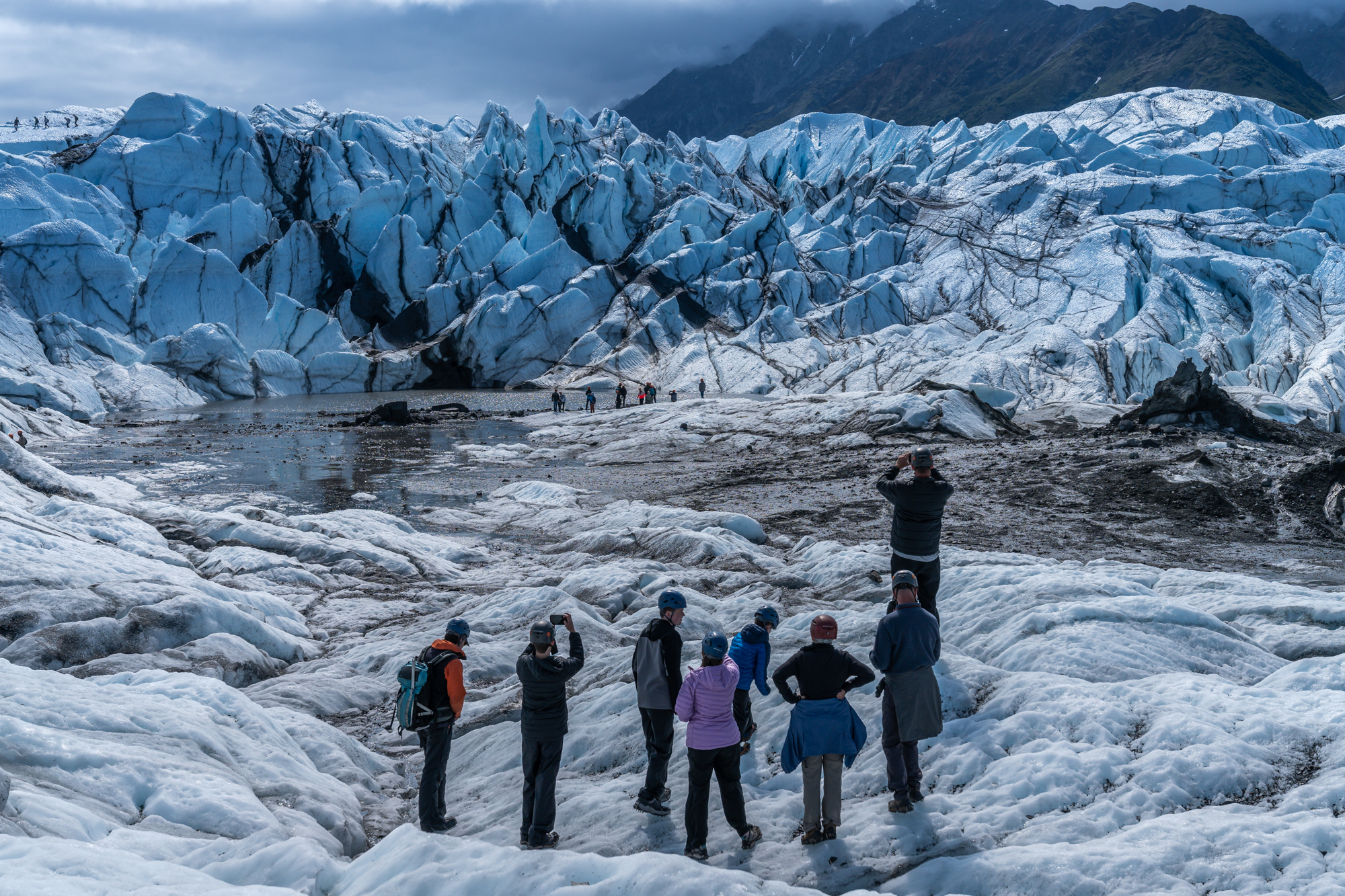
Explore the amazing blue glacier ice of Matanuska Glacier. We generally spend two hours and walk three miles on the ice. Includes round-trip transportation from Anchorage.
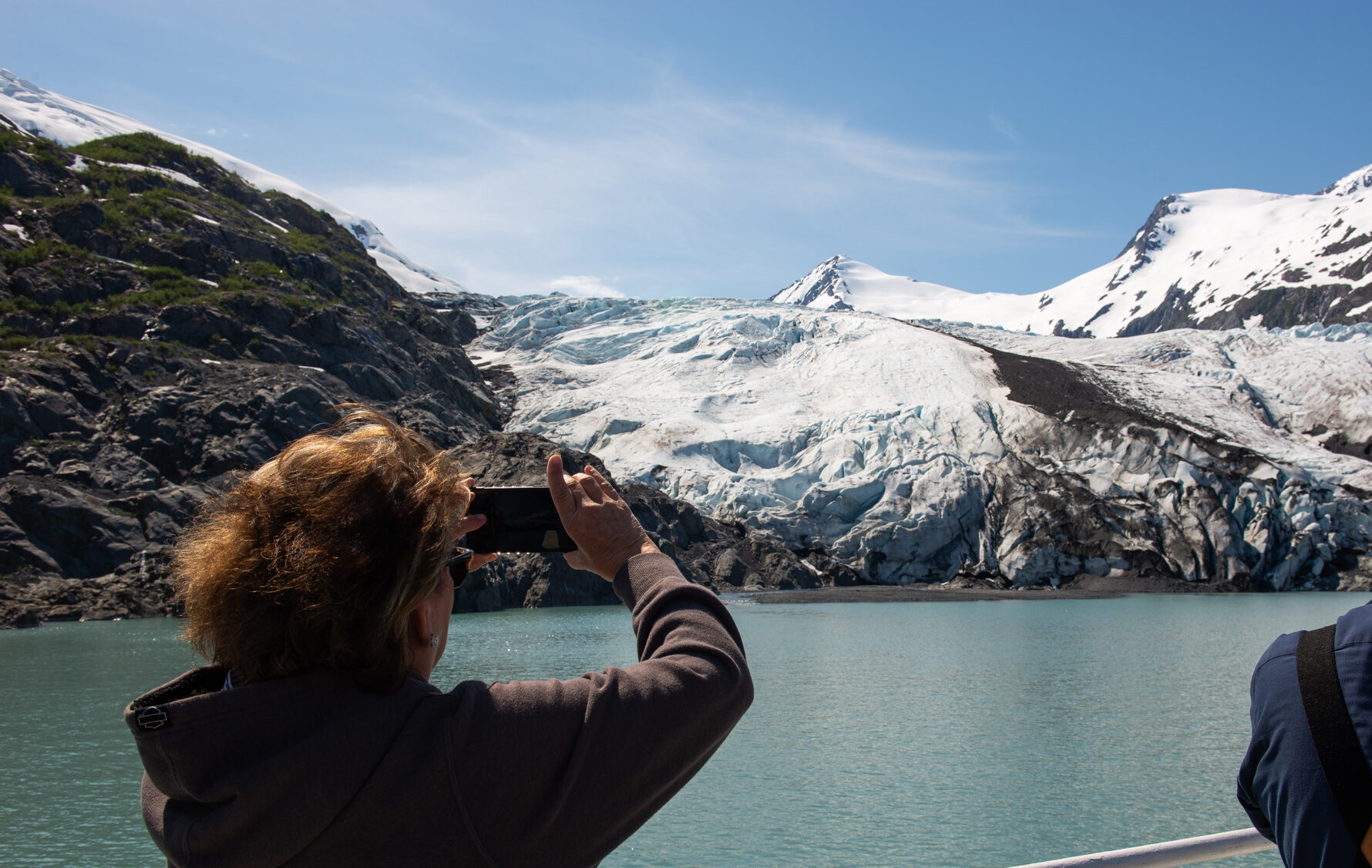
Travel the scenic Seward Highway along Turnagain Arm to Portage Valley. Take a scenic tram to the top of a mountain, cruise an iceberg dotted lake to view a glacier, and view Alaska's iconic animals up close. The choice is yours!